
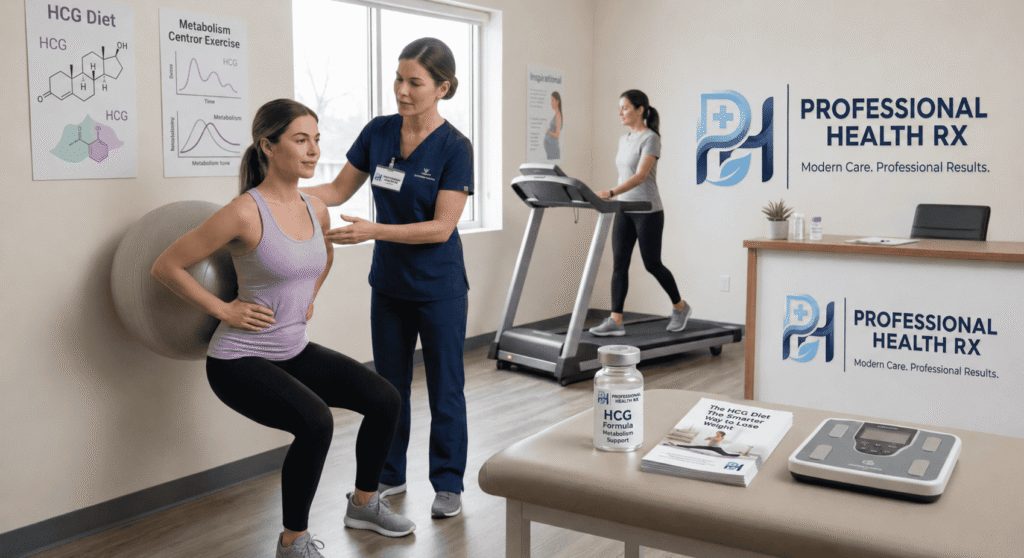
If you’re considering an HCG diet and wondering whether you can exercise while trying to lose weight, you’re not alone. Exercise is an important part of a healthy lifestyle, but the right amount and intensity depend on your calorie intake, overall health, fitness level, and medical treatment.
It’s also important to understand what HCG can—and cannot—do for weight loss.
HCG (human chorionic gonadotropin) is a hormone produced during pregnancy. While prescription HCG has approved medical uses, the FDA has not approved HCG for weight loss. Evidence does not show that HCG increases weight loss beyond the effect of calorie restriction.
If you’re considering HCG injections or another medically supervised weight-management program, talk with a qualified healthcare professional before making major changes to your diet or exercise routine.
Can You Exercise While Following an HCG Diet?
Exercise can support weight management, cardiovascular health, strength, mobility, and overall well-being.
However, traditional HCG diet programs often involve extremely low calorie intake. Some versions recommend around 500 calories per day. The FDA warns that such very-low-calorie diets can increase the risk of problems including electrolyte imbalances, gallstones, and abnormal heart rhythms and should not be followed without appropriate medical supervision.
Because of this, more exercise is not necessarily better when calorie intake is severely restricted.
If your healthcare provider has prescribed a medically supervised calorie-restricted plan, ask them specifically what level of physical activity is appropriate for you.
What Does the Research Say About HCG for Weight Loss?
HCG has been promoted for decades as a way to accelerate fat loss, reduce hunger, or help preserve muscle during severe calorie restriction.
Research has not supported these claims.
Controlled studies have found that people receiving HCG did not experience meaningful weight-loss advantages compared with people receiving placebo while following the same calorie-restricted diet. A review of clinical evidence also concluded that there is no scientific evidence that HCG effectively treats obesity.
The FDA states that there are no FDA-approved HCG products for weight loss and advises consumers to avoid products marketed as HCG weight-loss treatments.
This distinction matters because losing weight during a highly restrictive diet does not necessarily mean that HCG is responsible for the weight loss.
Why Exercise Still Matters During Weight Management
Even when weight loss is the primary goal, exercise offers benefits beyond the number on the scale.
Regular physical activity can:
- Support heart health
- Improve muscular fitness
- Help maintain strength
- Improve sleep
- Support healthy blood pressure
- Improve physical function
- Help with long-term weight maintenance
The CDC recommends that most adults work toward at least 150 minutes of moderate-intensity aerobic activity per week, along with muscle-strengthening activity on at least two days each week.
However, these are general recommendations for adults—not a prescription for someone following a severely calorie-restricted diet.
Your healthcare provider may recommend a different activity level based on your health and treatment plan.
What Types of Exercise Are Best?
For someone working toward healthy weight management, a combination of aerobic activity, strength training, and everyday movement can be useful.
Walking
Walking is one of the simplest ways to increase daily physical activity.
A brisk walk can raise your heart rate without placing excessive stress on your joints. If you’re new to exercise, start with short walks and gradually increase your time as your fitness improves.
Low-Impact Cardio
Depending on your fitness level, activities such as:
- Cycling
- Swimming
- Water aerobics
- Elliptical training
- Light recreational activities
can provide cardiovascular exercise with relatively low joint impact.
Strength Training
Strength training is especially valuable during weight loss.
Resistance exercises can help maintain muscular strength and function. The Physical Activity Guidelines also note that muscle-strengthening activity can help maintain muscle mass during weight loss.
Examples include:
- Resistance bands
- Bodyweight exercises
- Light free weights
- Weight machines
If you’re new to resistance training, consider working with a qualified fitness professional to learn proper technique.
Mobility and Stretching
Gentle stretching and mobility work can help you stay active and maintain range of motion.
These activities can be especially useful on days when you’re not doing more intense exercise.
How Much Exercise Should You Do?
There is no single HCG diet exercise plan that is appropriate for everyone.
Your exercise routine should take into account:
- Your current fitness level
- Your calorie intake
- Your age
- Your medical history
- Your medications
- Your sleep and recovery
- Your healthcare provider’s recommendations
If you’re eating very few calories, increasing exercise substantially can make it harder to recover and may increase the risk of fatigue, dizziness, weakness, or other problems.
Rather than trying to burn as many calories as possible, focus on safe, sustainable movement.
A Simple Approach to Getting Started
If your healthcare professional has cleared you for exercise, consider starting with manageable activities.
Beginner example:
Monday: 15–20 minute walk
Tuesday: Gentle mobility or stretching
Wednesday: 15–20 minute walk
Thursday: Rest or light movement
Friday: 15–20 minute walk
Saturday: Light strength training
Sunday: Rest or easy walking
This is only a general example—not a medical prescription.
As your fitness improves, your healthcare professional may recommend gradually increasing activity.
Can Exercise Help Preserve Muscle During Weight Loss?
Weight loss can involve changes in both fat mass and lean mass.
That makes muscle-strengthening activity an important part of many weight-management programs.
Resistance training gives your muscles a reason to remain active and can help support strength and muscle function during weight loss.
Adequate nutrition is also important. Extremely restrictive diets may make it difficult to consume enough protein and essential nutrients. The FDA specifically warns that very-low-calorie HCG diet programs may not provide adequate protein, vitamins, or minerals.
What About HCG Injections and Exercise?
Prescription HCG has legitimate medical uses, including certain fertility treatments and other hormone-related indications.
However, HCG is not FDA-approved as a weight-loss medication.
If you’re receiving HCG injections for a medical reason, don’t assume that an exercise routine designed for an HCG diet is appropriate for you.
Your exercise recommendations should be based on the condition being treated, your overall health, medications, and nutritional status.
If you’re using HCG specifically for weight loss, discuss the potential risks and evidence with a licensed healthcare professional.
Signs You May Be Exercising Too Much
Stop exercising and seek medical advice if you experience concerning symptoms such as:
- Severe dizziness
- Fainting
- Chest pain
- Significant shortness of breath
- Unusual or severe weakness
- Confusion
- Persistent vomiting
- A rapid or irregular heartbeat
These symptoms should not be ignored, particularly when you’re following a restrictive diet or taking medication.
The Problem With Extremely Low-Calorie HCG Diets
One of the biggest concerns surrounding the traditional HCG diet is not exercise itself—it’s the extreme calorie restriction often associated with the program.
The FDA warns that diets providing around 500 calories per day can be dangerous without proper medical supervision. Potential complications include gallstones, electrolyte abnormalities, and irregular heart rhythms.
For this reason, people should not attempt an extremely low-calorie diet simply because it is promoted as an HCG protocol online.
A healthcare professional can help determine whether a calorie-restricted approach is appropriate and how it should be monitored.
A Safer Approach to Weight Management
Long-term weight management usually requires more than a short-term diet.
A sustainable approach may include:
- A nutritionally balanced eating pattern
- Regular physical activity
- Strength training
- Adequate protein and nutrients
- Good sleep
- Stress management
- Regular medical follow-up when appropriate
- Evidence-based weight-management treatment when indicated
Physical activity is particularly important for maintaining weight loss over time. The CDC notes that regular activity can help with both weight management and overall health.
Frequently Asked Questions
Can you exercise while on an HCG diet?
Exercise may be possible for some people, but the appropriate amount depends on calorie intake, health status, fitness level, and medical supervision. Extremely low-calorie diets require particular caution.
Does HCG help you lose more weight?
Current evidence does not show that HCG produces additional weight loss beyond calorie restriction. The FDA has not approved HCG for weight loss.
Is walking good during weight loss?
Walking is a practical form of physical activity for many people. It can help increase daily energy expenditure and support cardiovascular fitness.
Is strength training useful during weight loss?
Yes. Strength training can help maintain muscular strength and may help preserve muscle mass during weight loss.
Should I exercise more to lose weight faster?
Not necessarily. Increasing exercise while severely restricting calories can increase fatigue and other risks. A healthcare professional can help determine an appropriate activity level.
Is the HCG diet safe?
The safety depends on the specific product and diet being used, but the FDA warns against HCG products marketed for weight loss and against unsupervised very-low-calorie diets.
Are HCG injections FDA-approved for weight loss?
No. FDA-approved prescription HCG products have specific medical indications, but HCG is not approved for weight loss.
Talk With a Healthcare Professional Before Starting
If you’re considering HCG injections, a very-low-calorie diet, or a new exercise program, speak with a qualified healthcare professional first.
Your weight-management plan should consider your medical history, current medications, nutritional needs, activity level, and long-term goals.
Professional Health RX can help you understand your options and determine whether a medically supervised weight-management approach may be appropriate for you.
Contact Professional Health RX to discuss your weight-management options.
Medical Disclaimer
This article is for educational purposes only and does not replace individualized medical advice, diagnosis, or treatment. HCG is not FDA-approved for weight loss. Do not begin a very-low-calorie diet, HCG treatment, or new exercise program without discussing it with an appropriately qualified healthcare professional.